
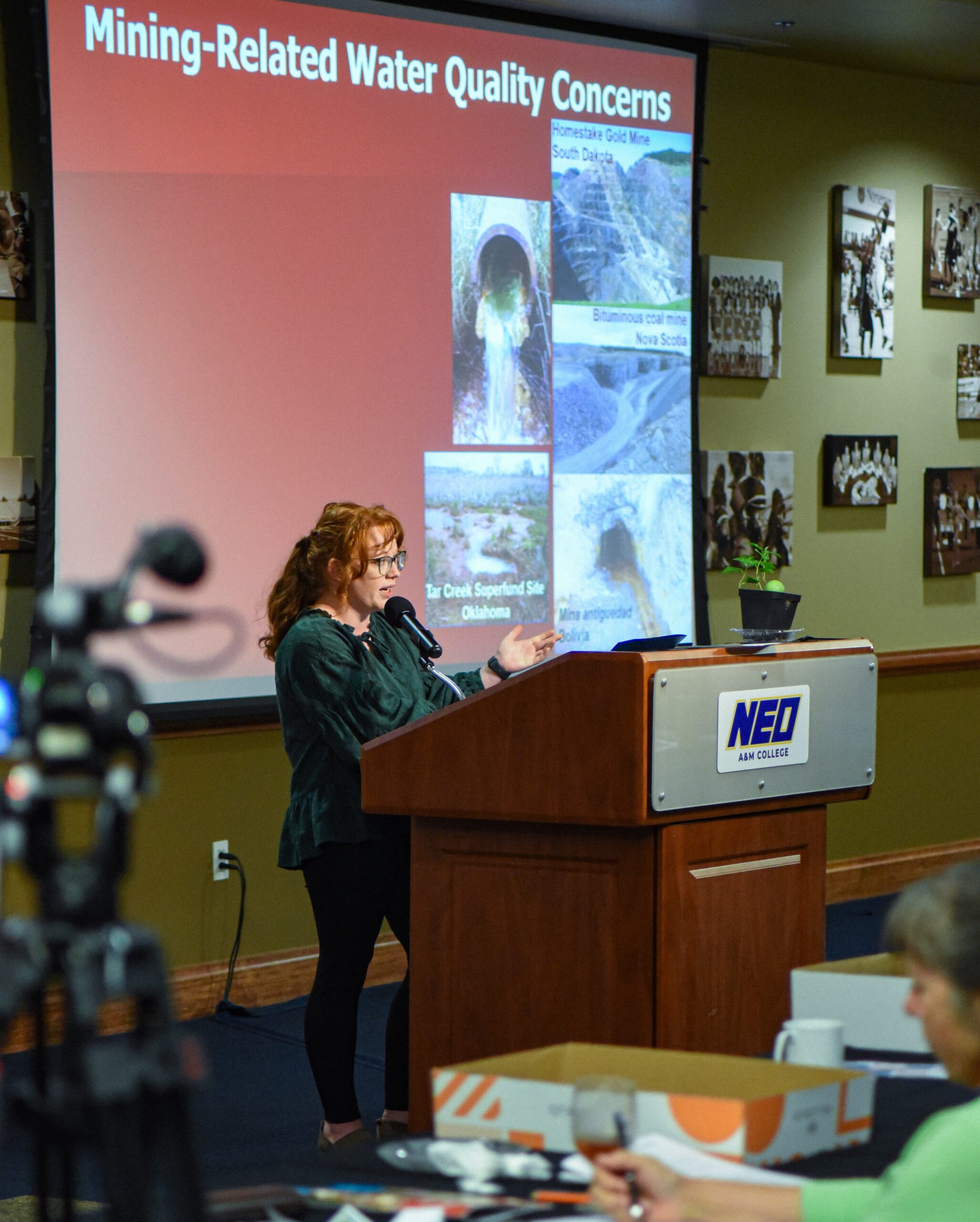
In 1979, after a near century of lead and zinc mining, the waters of Tar Creek ran red.
The water flowed to the surface from underground mine workings near Commerce, Oklahoma and drained into Tar Creek, drawing the attention of the US Environmental Protection Agency (EPA).
Decades of mining left the earth riddled with unmapped boreholes and cavities that filled with billions of gallons of water after the last miners packed their equipment and left Ottawa County’s Picher Field in the 1970s. The water wasn’t red underground, in the darkness of the mine workings, but as the lead-heavy water flowed out of the mines, it hit oxygen, staining the creek a rusty orange-red.
In 1983, EPA added Tar Creek to its Superfund National Priorities List, where it’s one of eight hazardous waste sites on Native American land in Oklahoma, agency records show. The Oklahoma Water Resources Board restricted use of Tar Creek to activities where ingesting water isn’t likely, like boating or wading, in 1985. The board found that mining operations had caused “irreversible man-made damages” to the creek that couldn’t be remedied, EPA records show.
Tar Creek still runs red, but M’Kenzie Dorman wonders if it has to stay that color. Through her work as a researcher with the Center for Restoration of Ecosystems and Watersheds (CREW) at the University of Oklahoma, she’s seen how science and engineering can transform and bring life back to this resource.

CREW runs two passive water treatment systems in Ottawa County. The systems use natural processes to remove thousands of pounds of iron, zinc, lead and cadmium from the water each year.
Downstream from the water treatment systems, the number of fish species has doubled since CREW began treating the water, Dorman said. River otters returned to the area in 2022.
“I’ll ask: Are these waters irreversibly damaged?” Dorman said during a presentation at nonprofit LEAD Agency’s Tar Creek Conference in October. “I would argue that they’re not. We’re able to take this orange water and make it clear again.”
Tar Creek is a “mega” and legacy site, making cleanup expensive and complicated
Tar Creek is on land the United States allotted to the Quapaw Nation. Years later, ores from Tar Creek were melted and cast into the majority of bullets and bombshells used by Americans during the World Wars. Decades later, workers abandoned the mines and left behind a maze of mine workings and 20-story-high stacks of gravel-like waste called chat piles that builders used to fill roads, alleys and driveways.
Blood lead levels showed Native American kids were disproportionately impacted by exposure to lead. Test results from the Oklahoma State Department of Health show blood lead levels have dropped in Ottawa County since peaking in the 1990s, but they’re still above the state average.
Tar Creek is considered a “mega-site,” a Superfund site that the EPA estimates will cost more than $50 million to remediate. It’s also one of the Superfund program’s legacy sites, which have been on the National Priorities List for decades without finishing remediation.
EPA still hasn’t developed a plan for addressing contaminants in the site’s surface waters, including rivers, streams and lakes, frustrating some engineers who have devoted their careers to Tar Creek remediation, EPA records show.
[ Read more: EPA excluded, then restored, data on Black people who live closest to toxic sites ]
EPA spokespeople didn’t make staff available for an interview and didn’t answer questions in writing for this story.
Tammy Arnold, director of environmental and conservation programs for the Quapaw Nation, which leads mining waste remediation at Tar Creek, declined an interview request.
EPA records conflict on whether the agency has started a report that’s required before remediation on Tar Creek’s watersheds can start
From its headwaters in Cherokee County, Kansas, Tar Creek flows through the former Picher Field mining area to the Neosho River, which flows into Grand Lake o’ the Cherokees, EPA records show. Residents, including tribal members, use the water for fishing, hunting, swimming and gathering.
According to an EPA report from September, the agency doesn’t expect to do any remediation to address Tar Creek’s surface water until 2030 at the earliest.
To start a remediation project at a Superfund site, EPA must publish a plan first, and to create that plan, the agency needs to complete a feasibility study. It’s not clear if EPA has started the feasibility study for Tar Creek’s watersheds based on conflicting information in reports published a month apart this year and the EPA website.
In August, EPA published a strategic plan for Tar Creek that said a feasibility study for the site’s surface water “is underway.” Another agency report published in September said that “rather than proceeding directly to a (feasibility study),” EPA plans to continue removing mining waste in and around streams under a separate site project that focuses on remediating chat piles and other waste.
EPA spokespeople didn’t answer if the agency has started the feasibility study, but a summary of Tar Creek remediation progress on EPA’s site says the study had a 2015 start site, and the agency hasn’t completed it. According to a previous version of the page viewed by Streetlight in June, the EPA deleted that the agency anticipated finishing the feasibility study sometime between December 2025 and February 2026.
[ Read more: For the first time since the 80s, the Census Bureau won’t conduct the biennial American Housing Survey this year ]
The EPA deleted a few other details from the page, according to previous versions of the site. The agency removed that it planned to start a clean-up proposal for Tar Creek’s surface water in September or November this year, with the goal to complete it by February 2027. The EPA also deleted that the agency estimated a 2027 start date for a remedial design for the site’s surface water.
In the EPA’s September report, several environmental program leaders seemed disappointed that remediation of Tar Creek’s surface water still hadn’t begun.
Jason White, environmental programs director for the Cherokee Nation, told interviewers he rated remediation for Tar Creek “good, except for” the surface water project. Kathleen Welch, environmental program manager for Wyandotte Nation, said the tribe “is waiting for” the cleanup plan and remediation of the site’s surface water.
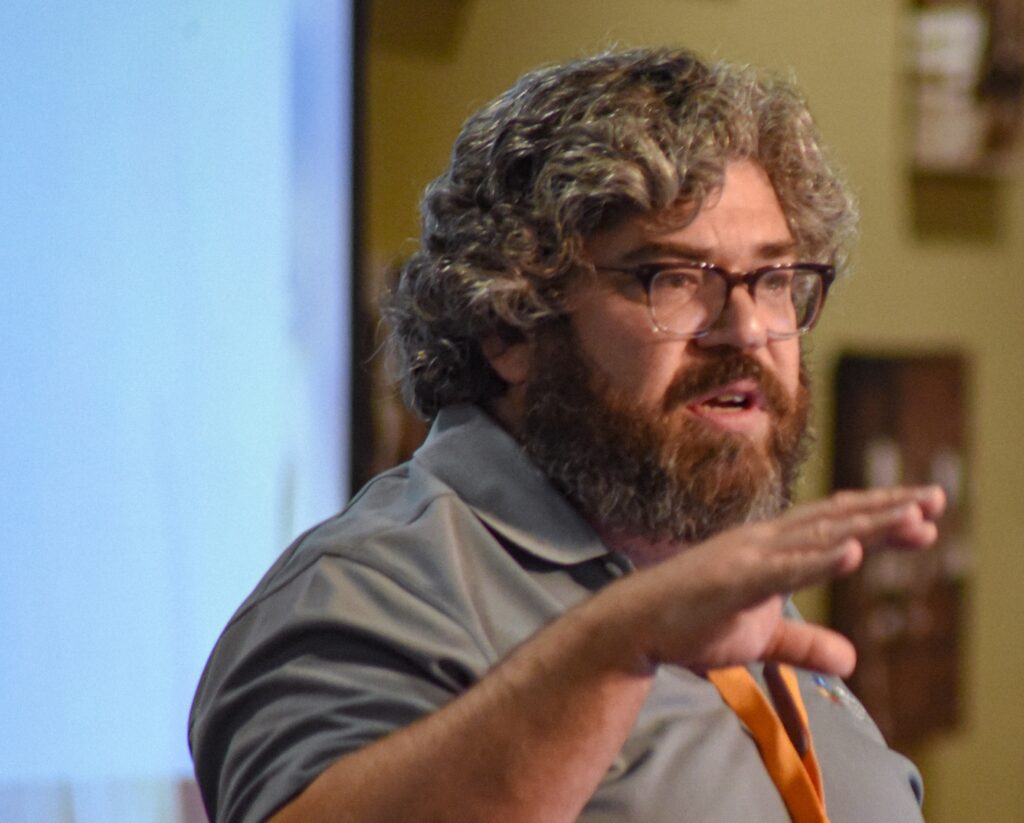
Brian Stanila manages the Oklahoma Department of Environmental Quality’s (ODEQ) site restoration and revitalization section, and he previously led cleanup assistance and remediation at Tar Creek for the agency.
In an interview for the EPA’s report from September, Stanila said he was “discouraged at the pace of progress” for remediating surface water at the Tar Creek site.
Asked why Stanila had felt discouraged, he emphasized the waters are part of seven watersheds, make up about 120 miles of river and affect three states and nine tribes.
“Coming up with one solution for all of that is complex and difficult, and I want it done as fast as possible, so whenever things aren’t done, there is some frustration there,” he told Streetlight.
“We’ve been collecting data for a long time,” he added. “We’re working on this and EPA’s working on it, but there’s … hundreds of stakeholders, and getting them all on the same page to move forward with anything is just complex. The frustration that I have is not with anybody but with the site that we have to deal with.”
[ Read more of our housing coverage ]
Robert Nairn is director of CREW and a professor in the University of Oklahoma’s School of Civil Engineering and Environmental Science. He said remediation delays aren’t unique to Tar Creek. Mega-sites are complex, and Tar Creek is especially so because it’s on Native land and was the most heavily mined area in the Tri-State Mining District, a cluster of four Superfund sites on former lead and zinc mining fields where Oklahoma, Kansas and Missouri meet.
“It just gets really, really complicated very quickly,” Nairn said. “I always tell my students when we visit and I take classes up there that the science and engineering challenges are real, but the social, economic and the cultural challenges are equally important. All of that lends itself to delays … in this decision-making process.”
When the EPA initially determined water treatment was too expensive, fewer options were available
The EPA splits Superfund site remediation into different projects. Tar Creek’s first remediation project initially touched on surface water but now focuses solely on groundwater.
In 1984, the EPA selected a plan to address contaminated ground and surface water at the Tar Creek site. For the surface water, ODEQ built a diversion dike, but EPA later determined the construction didn’t significantly reduce the amount of mine water flowing into Tar Creek, federal records show.
The EPA received a waiver essentially allowing the agency to not pursue additional remediation efforts for the surface water under that project because the costs involved were too high. A 2000 EPA report argued the agency shouldn’t reexamine the waiver because “the economics of the situation have not changed.” Engineering costs to address surface water contamination would still be “massive,” the report said.
“I think the thing that’s most disturbing,” Nairn said, “was the decision that the waters were untreatable, that the surface water was not something we could address in a cost-effective manner.”
[ Streetlight is news that empowers. Make a tax-deductible donation to support our journalism. ]
When the EPA invoked the waiver, passive treatment was brand new, Nairn said, and its use has since grown and advanced dramatically. Now the technology offers a cost-effective, sustainable alternative to active water treatment, which uses more energy, chemicals and costs more than passive treatment.
“The decision that we couldn’t treat these waters effectively probably made sense in 1984,” Nairn said. “I don’t think it makes sense today. Those waters are treatable. … They will recover if we clean up the chemistry.”
The EPA hasn’t ever revisited its original ground and surface water plan to consider using passive treatment. EPA reports from 2000 through this year have said the waiver remains appropriate for the site, agency records show.
EPA spokespeople didn’t answer if the agency would consider reopening its original ground and surface water plan to explore using passive treatment. They didn’t answer if the agency is considering passive treatment for its future surface water remediation project at Tar Creek.
More water treatment research is in the works for Tar Creek
Nairn said the Tar Creek Superfund area has three locations where poor-quality water flows out of underground mines: In Beaver Creek, the Douthat Bridge area near Cardin and an unnamed tributary near Commerce, where CREW operates its two passive treatment systems.
“We’re making appropriately treated, higher-quality water in those treatment systems,” Nairn said. “Those ideas are transferrable to the other two places. … We just need the resources to make that happen.”
Stanila said it’s possible passive treatment could be used during the site’s future surface water remediation project to address contaminated water flowing out of mine workings.
“We’re already on the pathway of doing that,” he said.
EPA’s Region 6 approved an ODEQ grant request for about $800,000, Stanila said, to go toward a project with CREW to study how to treat water flowing from the mines with a passive treatment system.
“The big challenge there is understanding how much flow is coming out of the ground because the mine workings are also interconnected,” Stanila said. “It can rain in Kansas and it discharges in Oklahoma, so characterizing how much water is coming out of the ground is the biggest issue when it comes to sizing a passive treatment system.”
In the meantime, Nairn has a message for students when he takes classes to Tar Creek. The history of the land—its allotment to the Quapaw Nation and then its role in bolstering two World Wars—isn’t so far in the past.
“These are things that happened 50, 100 years ago, but we’re still dealing with those problems today, and they’re not just technical,” Nairn said. “They’re not just things that you can do the calculation and fix the problem.”
Contact Streetlight editor Mollie Bryant at 405-990-0988 or bryant@streetlightnews.org. Follow her reporting on Bluesky or by joining our newsletter.
This article was supported by the Fund for Investigative Journalism.
Streetlight is a nonprofit news site based in Oklahoma City. Our mission is to report stories that envision a more equitable world and energize our readers to improve their communities. Donate to support our journalism here.