
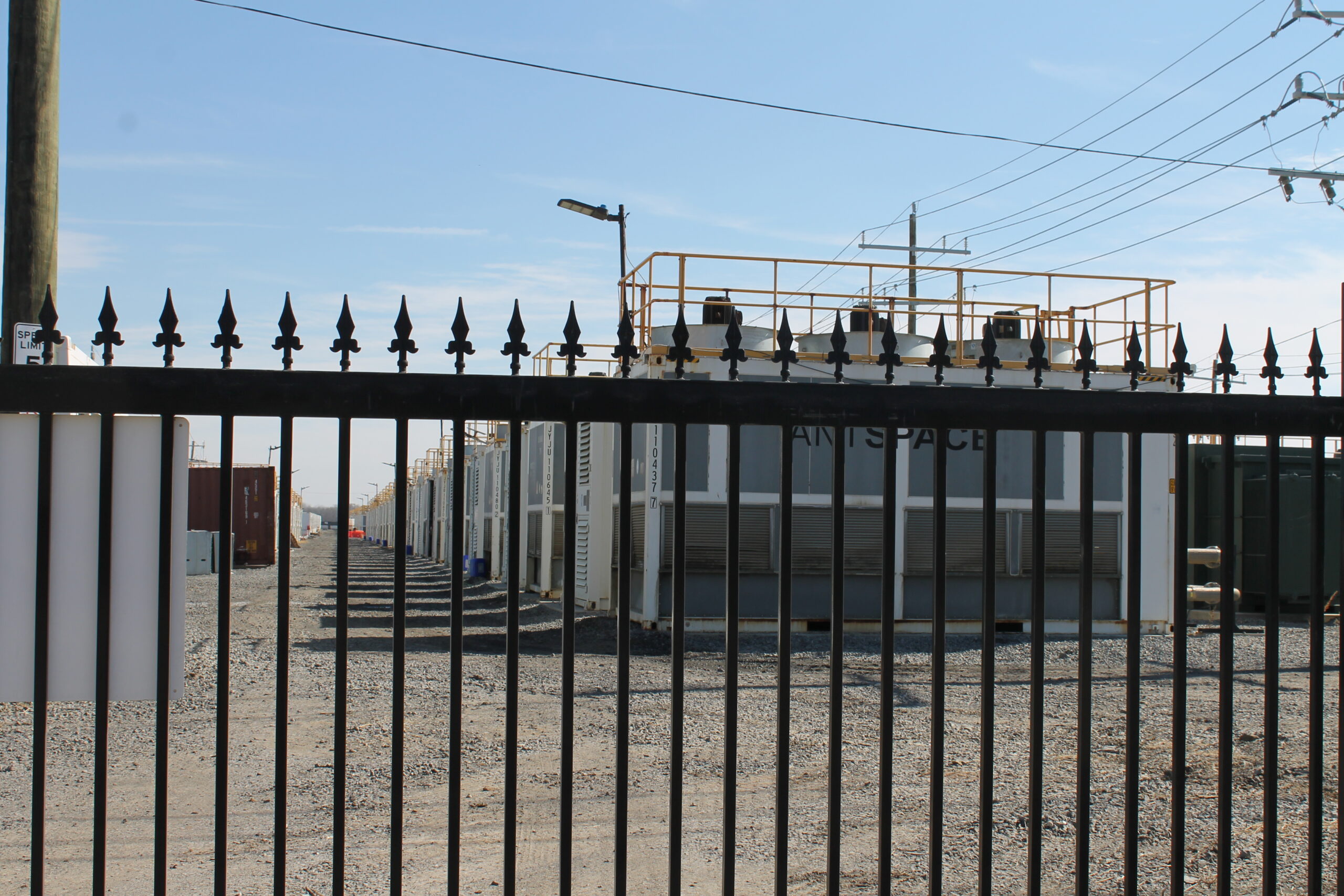
A Muskogee, Oklahoma data center has received workplace safety and state environmental violations while using millions of gallons of municipal water a day.
The Bitcoin mining facility run by Polaris, which didn’t respond to an interview request, is part of a race to bring more data centers to Oklahoma as technology companies double down on AI and cryptocurrency. Data centers’ heavy use of power and water has drawn criticism from Oklahomans like Mounds resident Darren Blanchard, who was arrested on a trespassing charge last week after going over the time limit for public comments at a Claremore City Council meeting on a proposed data center.
“Water’s a finite resource,” Blanchard told Streetlight. “During drought-prone months, they’re asking citizens to ration water and at the same time we have data centers using millions of gallons per day. I have trouble comprehending that.”
Power-hungry data centers for AI and cryptocurrency place heavy demand on power grids, push up energy costs for residents and consume high volumes of water needed to regulate the temperature of their systems. Consulting firm McKinsey & Company estimates that by 2030, data centers will account for 12% of electricity consumption in the United States.
Data centers rely on energy from fossil fuels, including diesel backup generators that pollute the air. They increase carbon emissions and release inhalable microscopic solid particles known as fine particulate matter, sulfur dioxide and nitrogen dioxide, according to research from University of California at Riverside and California Institute of Technology professors last year.
Those pollutants are linked to health problems, including lung cancer, asthma, heart attacks, cardiovascular disease, stroke and cognitive decline.
By 2030, the public health burden of data centers is estimated to hit $20 billion, double that of coal-based steel production, according to the study. Data centers are usually located near power sources, which are more likely to be in low-income communities, so those residents disproportionately experience health impacts from the centers.
A trio of data center projects arrive in Muskogee

Google and Core Scientific both have data center projects in Muskogee, an unexpected hotspot for data center development. With the Polaris site, those data centers surround an OG&E substation in an industrial park nestled between homes and agricultural land.
“Why are these industries all coming to Muskogee?” Muskogee Mayor Patrick Cale said during a city council meeting in June last year.
Kimbra Scott, director of the Muskogee City-County Port Authority, said the reason was OG&E’s 1,000-watt substation in the industrial park.

Most AI and cryptocurrency data centers receive electricity from local power grids and use backup generators to pick up the slack during grid outages. Those generators typically rely on diesel fuel, which produces air pollution and poses health risks to the public, according to the study by California researchers.
Four air permit applications for data centers in Oklahoma, including Google and Core Scientific’s data centers in Muskogee, describe using diesel storage tanks to power their backup generators.
The data center study recommended a standard reporting practice for companies to report criteria air pollutants, six common air pollutants that include particulate matter, carbon monoxide and nitrogen dioxide. Shaolei Ren, associate professor in University of California at Riverside’s electrical and computer engineering department and a co-author of the study, said companies sometimes publish sustainability reports, but they don’t typically include data on criteria air pollutants.
“It doesn’t mean they don’t have that information,” Ren said. “They have to track the criteria air pollutants and report that information to the local environmental authorities, but that information is not public.”
Polaris is OG&E’s biggest customer in the area, and the company wants to dodge a tax based on its energy usage
In press releases, Polaris has claimed to be a substantial source of revenue for Muskogee, but that’s based on the company using more electricity than any OG&E customer in the area and giving the city $1.2 million per year for water. Scott said during the city council meeting in June last year that Polaris used about 6% of Muskogee’s water supply, or 2 million gallons per day.
Last year, Polaris sued the city after councilors voted to annex Polaris’ land in the industrial park. The suit alleged Muskogee didn’t notify the company as required about the annexation, but in legal filings, the city said it had notified Polaris as required and the company had appeared at five public meetings and hearings about the annexation, including the meeting when the city council first voted to begin the process to annex the property.
Businesses in the city limits owe a franchise tax that amounts to 3% of their electricity usage.
Representing Polaris during the June Muskogee City Council meeting, lobbyist Daniel Chepkauskas said that Polaris’ No. 1 expense is electricity and suggested the tax wasn’t affordable.
“Do any of us know exactly what the profitability of Polaris is, how much they can absorb in additional fees?” he said. “I don’t think that we do, and they have the right to be profitable. They have the right to make tons of money.”
In late 2024, the Occupational Safety and Health Administration (OSHA) inspected Polaris in response to a complaint. According to OSHA records, the inspection found six violations and the company received an initial penalty of about $68,000.
OSHA records show during the inspection, the floor had coolant on it, and employees worked around energized circuits without wearing electrical protective equipment, including helmets. Polaris employees were working on electrical equipment and the center’s cooling system without being trained to do so, and they didn’t have safety procedures for shutting down the cooling system, OSHA records said.
The Oklahoma Department of Environmental Quality also inspected Polaris last year in response to a complaint and found several violations, agency records show. According to the inspection report, the company didn’t follow best practices to prevent sediment from entering Sam Creek.
This article was supported by the Fund for Investigative Journalism.